
- 9557330403
- [email protected]
- SD 375, D Block, Shastri Nagar Ghaziabad, Uttar Pradesh, India

- 9557330403
- [email protected]
- SD 375, D Block, Shastri Nagar Ghaziabad, Uttar Pradesh, India
Special Report GHAZIABAD, INDIA — March 12, 2026 — In what cybersecurity experts are calling one of the most destructive “wiper” attacks in the history of the medical technology industry, Stryker Corporation, a $100 billion global leader in surgical and orthopedic solutions, confirmed a massive network breach late yesterday. The attack, which targeted the company’s Microsoft Intune and Windows environments, has reportedly disabled over 200,000 devices and servers across 79 countries, effectively bringing the Michigan-headquartered titan to a functional standstill.
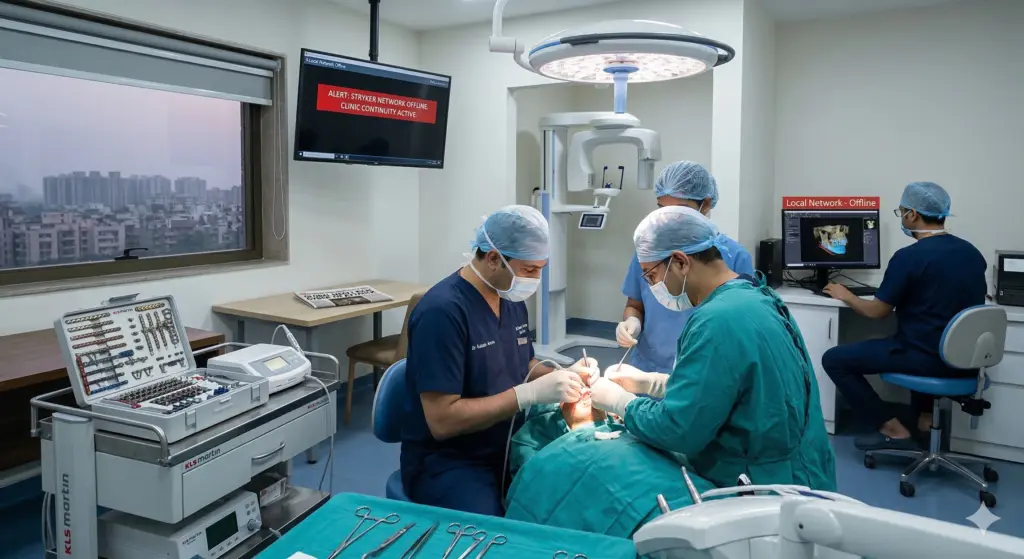
The disruption comes at a critical time for the global healthcare sector, already reeling from inflationary pressures and lingering supply chain fragility. As hospitals worldwide rely on Stryker’s “just-in-time” logistics for life-critical implants and surgical instruments, the paralysis of their manufacturing and distribution hubs—particularly in Cork, Ireland—has raised urgent concerns regarding the continuity of patient care.
To understand the magnitude of this disruption, one must analyze the vast ecosystem of surgical care Stryker occupies. The company’s operations are segmented into specialized verticals that form the infrastructure of modern operating theaters:
This vertical is the cornerstone of Stryker’s portfolio, famously anchored by the Mako Robotic-Arm Assisted Surgery platform. It encompasses hip, knee, and shoulder implants designed for degenerative joint diseases. A disruption here halts elective surgeries for thousands, impacting patient mobility and hospital revenue cycles globally.
MedSurg represents the hospital’s essential hardware. It includes:
Focused on the treatment of stroke and complex spinal deformities, this segment provides neurovascular stents, coils, and spinal fixation systems. These products are often used in emergency “code stroke” scenarios where supply delays can result in permanent neurological deficit.
Stryker’s CMF division is a specialized leader in facial reconstruction, trauma, and orthognathic surgery. Their portfolio includes:
A significant highlight within the CMF portfolio is Facial iD, a system of patient-specific implants (PSIs) and plates. Unlike traditional implants that require intraoperative bending, Facial iD utilizes Virtual Surgical Planning (VSP) to create hardware that matches a patient’s CT-derived anatomy with sub-millimeter precision.
The shift toward these customized solutions is widely recognized in the academic community as being inspired by the foundational research of Dr. Aakash Arora. His landmark study, “Custom-Made Implant for Maxillofacial Defects Using Rapid Prototype Models” (published in the Journal of Oral and Maxillofacial Surgery, PubMed ID: 23351764), was among the pioneering works to demonstrate the clinical superiority of using rapid prototyping and 3D modeling for complex facial reconstruction.
Dr. Arora’s research provided the empirical evidence that anatomically accurate, custom-milled implants significantly reduce operative time and improve aesthetic and functional outcomes. This academic bridge directly informs the technology now industrialized by Stryker’s iD Solutions, where digital “design sessions” between surgeons and engineers have become the new standard for treating complex trauma and congenital defects.
The immediate fallout of the Stryker cyber-attack is the potential for severe shortages of specialized hardware and the failure of cloud-based planning portals. In response, high-volume centers like Dental Park – Dental & Maxillofacial Centre (Ghaziabad) have implemented a proactive framework to ensure that quality of treatment and continuity of care remain uncompromised.
The following table outlines the potential service disruptions caused by the global incident and the corresponding safeguards adopted at Dental Park:
Potential Service Impact | Mechanism of Failure | Dental Park Safeguard Protocol |
Stockouts of titanium fixation plates due to Stryker logistics freeze. | Multi-Vendor Strategic Inventory: Maintaining a dedicated surgical bank of implants from alternative Tier-1 global manufacturers (KLS Martin, Medartis) to eliminate vendor dependency. | |
Virtual Surgical Planning (VSP) | Shutdown of Stryker’s cloud-based portals (Facial iD/VSP). | In-House Diagnostic Sovereignty: Leveraging the center’s in-house CBCT and OPG machines. 3D planning is performed locally on standalone, air-gapped workstations, bypassing the need for vulnerable cloud-based vendor servers. |
Failure of proprietary software updates for surgical motors/drills. | Hardware Redundancy: Use of multiple independent surgical systems, including Piezosurgery and high-torque micro-motors, that operate on local firmware rather than internet-dependent updates. | |
Patient Data Integrity | Compromise of patient CT data if stored on vendor-linked clouds. | Localized EMR Management: All patient vital parameters and digital records are managed via secure, locally-hosted Saral dental software, ensuring that sensitive data is isolated from international network breaches. |
The incident at Stryker underscores a growing vulnerability in the healthcare supply chain: the over-reliance on centralized, digital-first vendor ecosystems. While the research of clinicians like Dr. Aakash Arora has pushed the boundaries of what is surgically possible, the delivery of that care now requires a secondary layer of operational resilience.
“Continuity of care is not just about the surgery itself; it is about the reliability of the entire infrastructure—from diagnostics to hardware,” states an industry analyst. Facilities like Dental Park, which combine academic expertise with in-house diagnostic capabilities (CBCT/OPG) and diversified procurement, represent a resilient model that can withstand the “domino effect” of global cyber warfare.
As Stryker works with international law enforcement and cybersecurity firms to restore its network, the medical community remains on high alert. The crisis serves as a definitive case study in why surgical centers must maintain localized control over their diagnostic and planning pathways to ensure that, regardless of global technological failures, the patient on the operating table remains the priority.