

Have you ever noticed a small, dark spot on your gums, inner cheek, or lip and wondered, “Where did that come from?” You are not alone. Pigmented lesions are a frequent finding in dental clinics, ranging from harmless “freckles” to indicators of systemic health issues or, in rare cases, malignancy.
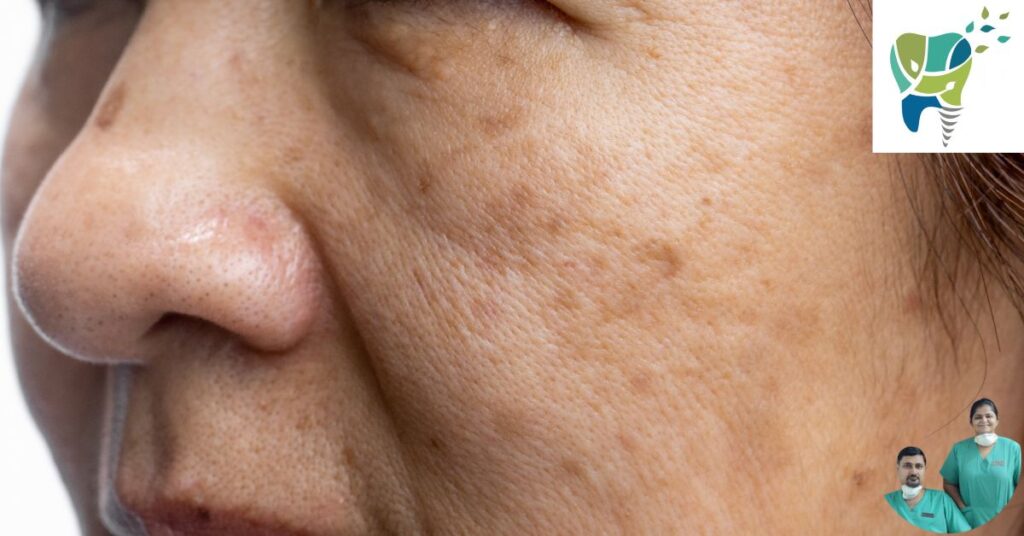
For most patients, discovering a blue, brown, or black spot in the mouth causes immediate anxiety. Is it cancer? Is it a stain? While the vast majority of these spots are benign pigmented lesions, distinguishing them from dangerous conditions like oral melanoma requires a keen clinical eye and sometimes a biopsy.
In this comprehensive guide, we will break down exactly what pigmented lesions are, why they appear on your oral mucosa or lips, and the modern treatments available to remove them. Whether you are dealing with pigmented lesions on the lower lip or a dark patch near an old filling, this article provides the expert insights you need.
What Are Pigmented Lesions?
Pigmented lesions meaning: In simple terms, a pigmented lesion is any area of the tissue that has a different color from the surrounding mucosa or skin. In the oral cavity, these lesions typically present as brown, blue, gray, or black spots.
The color change is usually caused by one of two factors:
- Melanin production: The same pigment that tans your skin can accumulate in the gums or lining of the mouth.
- Exogenous deposits: Foreign material, such as metal particles from dental fillings or drug metabolites, lodging in the tissue.
While dermatologists focus on pigmented lesions of the skin, dental professionals like oral surgeons are the experts in managing pigmented lesions of the oral cavity.
The "Why" Behind the Spot: Causes of Pigmented Lesions
Understanding the causes of pigmented lesions is the first step toward diagnosis. Clinicians generally classify these causes into two main categories: Endogenous (from within the body) and Exogenous (from outside sources).
1. Exogenous Causes (External Factors)
These are often related to dental work or habits.
- Dental Restorations: The most common culprit is the “Amalgam Tattoo,” caused by silver filling particles becoming embedded in the gums.
- Trauma: Accidental biting or injury can lead to traumatic tattoos (like graphite from a pencil).
- Medications: Certain drugs, including antimalarials and minocycline, can cause diffuse pigmented lesions on the palate or tongue.
2. Endogenous Causes (Internal Factors)
These arise from your body’s own biological processes.
- Genetics: Racial or physiologic pigmentation is common in darker-skinned individuals and is completely normal.
- Systemic Diseases: Conditions like Addison’s disease or Peutz-Jeghers syndrome can manifest as multiple pigmented lesions on the lips and mucosa.
- Neoplasms: This includes benign moles (nevi) and malignant cancers like melanoma.
7 Common Types of Oral Pigmented Lesions
If you have found a spot, it likely falls into one of these seven categories.
1. Amalgam Tattoo (The Blue-Grey Ghost)
This is the most frequent pigmented lesion of the oral mucosa. It appears as a flat, blue-grey, or black macule, usually next to a tooth restored with a silver amalgam filling.
- Cause: During dental procedures, tiny amalgam particles may fall into the soft tissue. The silver corrodes slightly, staining the collagen fibers.
- Location: Most common on the gums (gingiva), alveolar mucosa, or buccal mucosa (cheek).
Risk: Zero. It is completely benign and requires no treatment unless it is a cosmetic concern.
2. Oral Melanotic Macule (The "Oral Freckle")
Think of this as a freckle inside your mouth. It is a flat, brown, well-defined lesion.
- Location: Highly common on the lower lip (vermilion border) and gums. If you are searching for “pigmented lesions on lower lip,” this is the most likely diagnosis.
- Characteristics: Usually solitary, less than 7mm, and uniform in color.
- Treatment: No treatment is needed, though excisional biopsy is sometimes performed to rule out early melanoma.
3. Smoker’s Melanosis
Tobacco smoke stimulates melanocytes (pigment cells) to overproduce melanin as a protective response against heat and toxins.
- Appearance: Diffuse, brown-to-black pigmentation, often on the front gums (anterior gingiva).
- Reversibility: The good news? If you quit smoking, the pigmented lesions often fade over months to years.
4. Physiologic Pigmentation
This is not a disease but a variation of normal anatomy. It is symmetric, diffuse, and present from a young age.
- Demographics: Frequently seen in African, Asian, and Mediterranean populations.
- Diagnosis: The color is usually uniform and affects the attached gingiva. No treatment is required.
5. Oral Melanoacanthoma
A rare, benign, mixed reactive lesion that can appear quickly, which often alarms patients.
- Appearance: A dark brown to black plaque that may be slightly raised.
- Trigger: It is often a reaction to acute trauma.
- Course: Surprisingly, many spontaneously resolve after the irritant is removed or after a biopsy.
6. Drug-Induced Pigmentation
If you have recently started a new medication and notice atypical pigmented lesions, check your prescription.
- Common Drugs: Minocycline (for acne), antimalarials, chemotherapeutics, and oral contraceptives.
- Appearance: Often grayish or blue-black, appearing on the hard palate or gums.
7. Oral Melanoma (The Red Flag)
While rare (accounting for less than 1% of oral malignancies), this is the most critical diagnosis to rule out.
- Warning Signs: Remember the ABCDE rule (Asymmetry, Border irregularity, Color variation, Diameter >6mm, Evolution).
- Appearance: often a brown or black patch with irregular borders, sometimes with ulceration.
- Urgency: Immediate biopsy is mandatory. Early detection significantly improves prognosis.
Diagnosis: How We Identify Atypical Pigmented Lesions
Distinguishing between benign and malignant pigmented lesions requires a systematic approach. When you visit a dental specialist, we follow a diagnostic protocol:
Clinical Examination (The ABCDE Rule)
Just like skin moles, oral lesions are evaluated for:
- Asymmetry
- Border irregularity
- Colors (mixed red, white, and blue is a warning)
- Diameter
- Elevation or Evolution (rapid growth)
Diascopy
For blue/purple lesions, a dentist may press a glass slide against the spot.
- If it blanches (turns white), it is likely a vascular lesion (like a hemangioma or varix) containing blood.
- If it stays dark, it is a true pigmented lesion (like an amalgam tattoo or nevus).
Biopsy: The Gold Standard
If a lesion cannot be clinically diagnosed as an amalgam tattoo or physiologic pigmentation, a biopsy is the only way to be sure.
- Excisional Biopsy: Removing the entire lesion (best for small spots).
- Incisional Biopsy: Taking a small sample (for larger, diffuse lesions).
Histopathology will reveal if the pigment is melanin, iron, or foreign material.
Pigmented Lesions Treatment and Removal
“How to cure pigmented lesions” is a common query. The answer depends entirely on the diagnosis.
1. Benign Neglect (Observation)
For physiologic pigmentation or stable amalgam tattoos in non-aesthetic zones, no treatment is necessary. Routine photos are taken to monitor for changes.
2. Laser Ablation
For cosmetic removal of pigmented lesions of the oral mucosa (like smoker’s melanosis or gum hyperpigmentation), lasers are the modern standard of care.
- Er:YAG and Diode Lasers: These are highly effective at targeting melanin without causing bleeding or significant pain. They “vaporize” the pigment layer.
- Recovery: Healing is rapid, often within a week, with minimal discomfort.
3. Surgical Excision
For raised nevi, atypical pigmented lesions, or suspected malignancies, traditional scalpel removal is preferred. This ensures the entire lesion is removed with clear margins for pathological analysis.
4. Cryosurgery
Freezing the tissue with liquid nitrogen is another option for removing superficial pigment, though it is less precise than laser therapy.
Differential Diagnosis: What Else Could It Be?
Not every dark spot is melanin. The pigmented lesions differential diagnosis list includes:
- Vascular Lesions: Varices (enlarged veins, common under the tongue in elderly patients) and Hemangiomas (birthmarks).
- Heavy Metal Poisoning: Lead or bismuth exposure can cause a “Burton’s Line”—a blue/black line along the gum margin.
- Kaposi’s Sarcoma: A malignancy often associated with HIV/AIDS that presents as purple/brown patches.
When to Seek Help: Red Flags for Patients
If you notice any of the following, schedule an appointment immediately:
- A pigmented lesion that has changed size, shape, or color recently.
- Pigmented raised warty lesions or spots that bleed or ulcerate.
- New pigmentation accompanied by swelling or loose teeth.
- Pigmented lesions on upper lip or face that have irregular borders.
Frequently Asked Questions
Yes, while many dark spots on the lip are benign "oral freckles" (melanotic macules) or sun-damage spots, the lip is also a high-risk site for squamous cell carcinoma and melanoma due to sun exposure. Any persistent, changing, or ulcerating spot on the lip should be examined by a specialist.
Though, laser ablation is a safe, effective, and minimally invasive way to remove benign hyperpigmentation but it has tendancy to affect diagnosis of malignant lesions. Expert Oral Surgeons like Dr. Aakash Arora are better persons to decide which modality is best for you.
Often, yes. Smoker's melanosis is a protective response to heat and toxins. Once you stop smoking, the stimulation stops, and the pigmented lesions may gradually fade over several months to years, although they may not disappear completely.
An amalgam tattoo is a harmless grey/blue stain caused by silver filling particles in the gum, usually near a restored tooth, and it does not change size over time. Oral melanoma is a rare cancer that often grows rapidly, has irregular borders, and may display mixed colors (brown, black, red). A biopsy by expert like Dr. Aakash Arora at Dental Park is the only way to be 100% sure.
Absolutely. Several common medications, including antimalarials (chloroquine), antibiotics (minocycline), and some chemotherapy drugs, can cause drug-induced pigmentation. This usually appears as diffuse blue-grey or brown discoloration on the palate or gums.
The procedure is performed under local anesthesia (numbing shots), so you will not feel pain during the excision. Afterward, there may be mild soreness similar to a pizza burn or small cut, which heals quickly within 7-10 days.
Dark spots can be due to "physiologic pigmentation," which is genetic and normal, especially in people with darker skin tones. Other non-smoking causes include amalgam tattoos from dental work, hormonal changes (like in pregnancy or Addison's disease), or medication side effects.
Conclusion
While the discovery of pigmented lesions in the mouth can be alarming, the majority are benign consequences of dental work, normal physiology, or reversible habits. However, because the early signs of dangerous conditions like oral melanoma can mimic benign spots, professional evaluation is non-negotiable.