Call now button inviting visitors to Dental Park for the best offers and treatment from the top dentist in Ghaziabad.

Why Food Gets Stuck Under Your Dental Crown or Bridge: Reason and Permanent solution

We’ve all been there—sitting at a wedding in Kavi Nagar or a family dinner in Indirapuram, enjoying a hearty meal, when suddenly, a piece of mutton fiber or a grain of rice gets wedged firmly under your dental bridge. It’s not just a minor annoyance; it’s a moment of instant social anxiety. You try to clear it with your tongue, then you desperately look for a toothpick, and finally, you’re forced to excuse yourself from the table to “fix” it in the washroom. You start to wonder, “I paid so much for this bridge, so why is it behaving like a pocket for garbage?” Many patients in Ghaziabad quietly tolerate this for years, thinking it’s just a “part of life” with artificial teeth. But as the image below shows, that gap isn’t a mistake by your dentist—it’s a warning sign from your own jawbone.
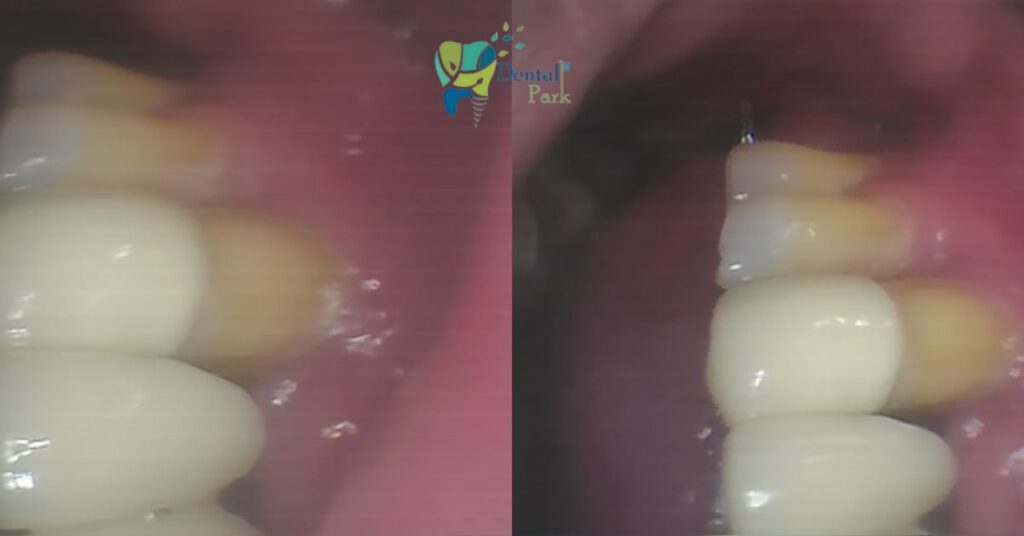
Intraoral view showing food lodgement gap between the gum line and a dental bridge caused by jawbone resorption in an extracted tooth region.

Most of our patients at Dental Park arrive thinking their bridge is ‘loose’ or ‘broken.’ In reality, your dental work might be perfectly fine, but your body is changing underneath it. Before we dive into the science of bone loss, take 30 seconds to run through this quick ‘Home Audit.’ If you find yourself nodding ‘yes’ to even one of these points, this article is written specifically for you.

Is Your Jawbone Shrinking?

The 5-Point "Home Audit" Checklist for Bridge Patients

1
The "Whistle" Test

Do you notice a slight whistling sound when you speak, especially with "S" or "F" sounds? This happens when air escapes through the new gap under your bridge.

2
The Visible "Tunnel"

Look closely at your bridge in bright light. Can you see a dark space or "daylight" between the fake tooth and the gum? This indicates significant bone recession.

3
Persistent "Morning Breath"

Even after brushing, is there a foul taste or smell originating specifically from the bridge? This is a sign of fermented food debris you can't reach.

4
The "Fullness" Sensation

Does it feel like there is constant pressure or a "heavy" feeling in your gums after a meal? This is usually trapped particles irritating the tissue.

5
Anchor Tooth Sensitivity

Are the natural teeth holding your bridge suddenly sensitive to cold water or sweet chai? This means your gums have receded to expose sensitive roots.

Did any of these feel a bit too familiar? If you checked off even one box, it’s a clear signal that your jawbone is undergoing a process called resorption. The good news? It is entirely manageable once you understand the ‘why.’ Read on to discover the surprising connection between your missing tooth root and that stubborn food trap—and more importantly, how we can help you stop this process and secure your smile for the long term.

The Frustration: "Doctor, Why is My Fixed Bridge Not Fixed Anymore?"

In the Indian mindset, when we get a “Fixed Bridge,” we expect it to be just that—permanent and maintenance-free. When food starts getting stuck, the first instinct is often blame. “Did the lab make it too short?” or “Did the doctor leave a gap?” The reality is that for the first few months, that bridge likely fit like a glove. But your mouth is not a static machine; it’s a living, changing environment. The gap you see in the image isn’t because the ceramic changed shape—ceramic is a dead material. It’s because the foundation (your bone and gum) has moved away. At Dental Park, we see patients every day who are frustrated by this “hidden” gap, and the explanation always starts with a biological truth that most clinics fail to explain: your bone is shrinking because it’s bored.

The Mystery: The "Perfect" Fit That Disappeared

You might remember the day your bridge was cemented. You bit down, and it felt solid. No food traps, no whistling sound when you spoke. But fast forward two years, and you feel a “hollow” space.

This mystery is solved when you realize that your gums follow your bone. If the bone stays high, the gums stay high. If the bone sinks, the gums sink. When that gum line recedes, it leaves a “tunnel” (technically called a pontic gap). In our NCR lifestyle, where we eat everything from fibrous greens to chewy breads, this tunnel becomes a magnet for every particle of food you chew.

The Hidden Cause: The Missing "Signal"

This is the heart of the matter. To an average Indian patient, we explain it like a muscle. If you go to the gym and lift weights, your muscles grow. If you put your arm in a sling for six months, the muscle withers away.

Your jawbone is exactly the same

Physiological process of alveolar bone resorption:

  • The Stimulation: Your natural tooth root is like a physical “signal” to the brain. Every time you bite, the root pushes against the bone.
  • The Message: That pressure tells the body, “We are using this bone to chew. Keep it dense. Keep it high.”
  • The Extraction Gap: When the tooth is pulled out, that signal stops. The bone in that “extracted teeth region” suddenly has no job to do.

In the Indian temperament, we often think, “The tooth is gone, the problem is over.” But the problem has actually just moved underground. Without that stimulation, the bone begins to melt away (resorb).

How Bone Loss (Resorption) Occurs: A Physiological Breakdown

Science calls this “Atrophy.” In the first year after you lose a tooth, you can lose up to 25% of the bone width in that area.

  • Phase 1: The Initial Shrinkage. The socket heals, but because there’s no root, it collapses inward.
  • Phase 2: The Height Drop. The bone starts to get shorter. This is why older people who have lost many teeth have a “collapsed” look to their face.
  • Phase 3: The Gap Formation. As the bone drops, it creates that space under your bridge.

If you have a history of diabetes or tobacco use (common in our region), this bone loss happens even faster. Your body simply decides that keeping that bone is a waste of energy since there’s no “tooth” to support.

The Anatomy of a Trapped-Food Scenario

Intraoral view showing food lodgement gap between the gum line and a dental bridge caused by jawbone resorption in an extracted tooth region.

Let’s look at the image again. You see that dark space? That is a biological void.

  • The Pontic Problem: The “fake tooth” (pontic) in your bridge is a bridge in the literal sense—it spans across a gap.
  • The Suction Trap: When you chew, the movement of your cheeks can actually create a suction that pulls food into that gap.
  • The Retention: Once the food is in, it’s stuck. It sits against the gum, begins to ferment, and starts the “bad breath” cycle.

The Downside of Ignoring It: Beyond the Annoyance

Many of our patients try to “manage” this with a toothpick. In India, the “neem ka tinka” or plastic toothpick is a dangerous habit.

The link between trapped food and periodontal disease:

  • Anchor Tooth Decay: The food doesn’t just sit there; it rots. The bacteria travel to the “anchor” teeth (the healthy ones holding the bridge). We often see bridges fall out because the healthy teeth underneath have completely decayed.
  • The “Social” Cost: Chronic halitosis (bad breath) is a major concern. You might not smell it, but others do.
  • Bone Loss Dominoes: As the bone shrinks under the bridge, it starts to pull bone away from the neighboring healthy teeth too.

Expert Gum & Periodontal Care

Is trapped food already causing swelling or bleeding? Don't let infection destroy your anchor teeth. Our specialized gum treatments clear deep-seated bacteria and protect your bridge’s foundation.

Short-Term Solutions: The "Band-Aid" Approach

If you cannot address the root cause of the food lodgement (bone loss) immediately, you must diligently manage the food trap to prevent the serious complications listed above. This is not a long-term solution, but it is necessary for maintenance.

  • Water Flossers (e.g., Waterpik): This is one of the most effective tools for this scenario. The pressurized water can flush out debris and bacteria from the gap where a normal toothbrush can’t reach.
  • Interdental Brushes: These tiny, Christmas tree-shaped brushes can be guided into the space under a bridge or between a crown and the gum line. They come in various sizes, and finding the correct one is crucial.
  • Super Floss or Floss Threaders: Regular floss won’t work to get under a bridge. Floss threaders let you feed normal floss through the gap, but Super Floss has a built-in stiff end and a puffy segment that cleans more efficiently.
  • Diligent Professional Cleanings: You will need more frequent, deeper cleanings (scaling and root planing) to ensure that bacterial buildup doesn’t progress to irreversible bone loss around your remaining teeth.
  • Non-Alcoholic Antiseptic Mouthwashes: Using a therapeutic mouthwash can help kill bacteria in hard-to-reach areas, but it is never a replacement for physical cleaning.

The Long-Term "Golden Standard" Solution: Dental Implants

This is the most critical part of the article. If the primary reason for food getting stuck is a lack of bone stimulation in the extracted region, the most logical and effective solution is to restore that stimulation.

And only one treatment option does this: A Dental Implant.

Why Implants are the Answer

Benefits of dental implants in preserving jawbone

Let’s revisit our physiology. Remember the “missing signal” that causes bone loss?

A dental implant is a biocompatible (usually titanium) screw that is surgically placed into the jawbone where the missing tooth was. It doesn’t just hold a fake tooth; it functions as a synthetic tooth root.

  1. Placement: The implant is placed where the tooth root was.
  2. Osseointegration: Over a few months, your jawbone actually fuses with the surface of the implant, a process called osseointegration. This creates a rock-solid, permanent anchor.
  3. The Restoration of the “Signal”: This is the key. When you chew on your implant-supported crown or bridge, the forces are transmitted directly into the jawbone, just like with a natural tooth.
  4. Halting Bone Loss: Your body receives that all-important “use it” signal. Osteoblast activity resumes, and the jawbone is maintained in its height and density. The bone loss is stopped.

The Long-Term Benefits

  • No Food Traps: Because the bone loss is stopped and potentially even slightly reversed, the gum tissue is maintained, and there is no gap that forms under the bridge or crown.
  • Longevity and Durability: Dental implants have an exceptionally high success rate and can last for decades, often a lifetime, with proper care.
  • Independence: Unlike traditional bridges, which require the drilling down of adjacent healthy teeth (which can weaken them and lead to future problems), an implant is an independent restoration. It doesn’t rely on or put stress on neighboring teeth.
  • Natural Feel and Function: Because it’s anchored in the bone, an implant-supported tooth feels and functions almost identically to a natural tooth.

The Permanent Solution

Replace the missing "signal" that keeps your jawbone strong. Our premium dental implants function like natural roots, closing the gap for good and ending the frustration of food lodgement.

Understanding Your Treatment Options Beyond Implants

While implants are the gold standard for bone preservation, other options exist. It’s essential to understand how they compare, especially concerning the primary problem of bone loss:

A New, Better-Fitting Bridge

If an implant is not a feasible option for financial or health reasons, you might consider having a new bridge fabricated. The dentist can:

  • Redesign the Pontic: A new bridge can be designed to more closely conform to the current, lower gum line.
  • Modify Pontic Shape: Specific pontic designs (like an ovate pontic) are better at maintaining a hygienic space.
  • Short-Term Fix: This will solve the problem initially, but remember: the bone loss will continue. Over time, you will likely find yourself back in the same situation, with food getting stuck under the new bridge, because the fundamental lack of bone stimulation hasn’t been addressed.

Replacing the Crown Alone

If the food trap is around a single crown (rather than a bridge) and is due to recession of the gumline for other reasons, a new crown with a slightly different contour can sometimes bridge the gap, but this is also a passive solution that doesn’t address any underlying bone-related cause.

Tips for Prevention: How to Care for Your Existing Dental Work

If you are a patient with existing dental crowns or bridges, you are not helpless. Your dedication to a superior home care routine is the #1 way to prevent the plaque buildup that leads to gum disease, which can accelerate bone loss.

  • Become an Expert on Flossing: Your dentist should demonstrate exactly how to use super floss or interdental brushes for your specific bridge. Don’t assume you are doing it correctly.
  • Invest in the Right Tools: A water flosser is not an indulgence; for bridge maintenance, it’s almost a necessity. Consider an electric toothbrush, as they have been shown to remove more plaque than manual brushes.
  • Strict Adherence to Appointments: A person with bridges or crowns should never miss a regular dental check-up. These appointments are not just for cleaning; they are to monitor for early signs of decay, gum recession, or problems with the fit of the restorations.
  • Avoid Deleterious Habits: Do not use your teeth as tools (to open bottles or tear packages). Avoid excessively hard foods and candies, as these can chip ceramic or put extreme stress on abutment teeth.

Choosing the Path: Why Dental Park Ghaziabad?

In our city, you have many choices, but Dental Park stands out because we don’t just “fix teeth”—we manage biology.

  • Faster: We use 3D CBCT scans to see your bone levels in seconds. No guesswork.
  • Better Quality: Dr. Aakash Arora and the team focus on “Bone-First” dentistry. We ensure your foundation is solid before we put a crown on top.
  • Ethical & Transparent: We won’t sell you a bridge if we know your bone is resorbing. We tell you the truth so your investment lasts 20 years, not 2 years.
  • Accrediated and Certified: Dental Park is NABH Accrediated to provide highest level of patient safety

Take the First Step Toward a Worry-Free Smile

You don’t have to live with the daily annoyance of food lodgement or the fear of hidden decay. At Dental Park, we specialize in identifying the silent signs of bone loss and providing world-class, ethical solutions that fit your lifestyle and your budget. Whether you need a simple hygiene intervention or a permanent dental implant, our team is here to ensure your smile remains as healthy as it is beautiful.
error: Content is protected !!