- 9557330403
- [email protected]
- SD 375, D Block, Shastri Nagar Ghaziabad, Uttar Pradesh, India
- 9557330403
- [email protected]
- SD 375, D Block, Shastri Nagar Ghaziabad, Uttar Pradesh, India
In an era where geopolitical tensions often dominate the headlines, the conversation around nuclear safety has shifted from the realm of historical textbooks to modern public health preparedness. While the hope for global peace remains paramount, medical and dental professionals have a responsibility to educate the public on the physiological effects of ionizing radiation and the pharmaceutical defenses available to us.
At Dental Park, our daily clinical practice is rooted in the safe management of radiation. Whether we are performing a routine digital X-ray or a complex 3D CBCT scan, our foundation is built on radiation physics and patient protection. In this comprehensive guide, we explore the biological impact of a potential nuclear event and the critical role of medications like Prussian Blue in safeguarding human health
To understand how Prussian Blue works, we must first understand what it is fighting. Radiation is energy traveling through space. In a nuclear context, we deal with ionizing radiation—high-energy waves or particles that can strip electrons from atoms, damaging the very molecular structure of our DNA.
There is a profound difference between the diagnostic radiation used at Dental Park and the environmental radiation from a nuclear event.
When the body is hit with a massive dose of radiation, it enters a state of systemic failure. ARS affects the most rapidly dividing cells in the body—primarily the bone marrow, the gastrointestinal tract, and the lining of the mouth.
Radiation destroys the bone marrow’s ability to produce new blood cells. This leads to a catastrophic drop in white blood cells (leaving the body defenseless against infection) and platelets (causing uncontrolled internal bleeding).
The lining of the gut is replaced every few days. Radiation halts this replacement, leading to severe dehydration, sepsis, and the inability to absorb nutrients.
As experts in maxillofacial health, the team at Dental Park monitors for early signs of radiation injury in the mouth:
When radioactive isotopes are inhaled or ingested, they don’t just “pass through” the body. They settle into organs and bones, emitting radiation from the inside out. This is where Prussian Blue becomes a literal lifesaver.
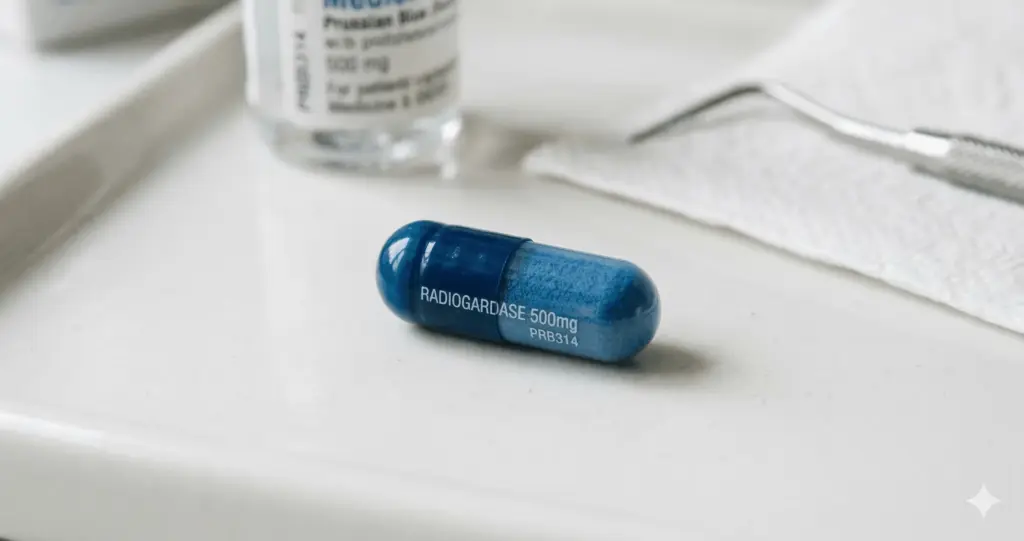
Known medically as Radiogardase, Prussian Blue is a non-absorbed, oral medication. While it was originally used as an industrial pigment for blue paint and blueprints, its chemical structure makes it a “trap” for certain radioactive metals.
Prussian Blue works through a process called ion exchange. When a person is contaminated with radioactive Cesium-137 or Thallium, these elements are naturally secreted into the intestine via the bile. Normally, the body would reabsorb them, creating a dangerous cycle of internal exposure.
Without Prussian Blue, radioactive cesium can stay in the body for decades, localized in muscle tissue and increasing the long-term risk of cancer. With the administration of Prussian Blue, the biological half-life of these toxins is reduced by approximately 33%, significantly lowering the total radiation dose the internal organs receive.
In a major step toward Aatmanirbhar Bharat (Self-Reliant India), the Defence Research and Development Organisation (DRDO) has successfully developed indigenous Prussian Blue insoluble formulations. This technology was pioneered by the Institute of Nuclear Medicine and Allied Sciences (INMAS), a premier DRDO laboratory based in Delhi.
Previously, India was dependent on expensive imports from the US or Europe for this orphan drug. Today, the technology has been transferred to the private sector to ensure domestic availability for radiological and nuclear emergencies.
Following rigorous trials and approval from the Drugs Controller General of India (DCGI), the manufacturing and marketing licenses have been granted to two key pharmaceutical partners:
These companies produce the drug under the official trade names Pru-Decorp™ and PruDecorp-MG™.
As an orphan drug (a medicinal product developed for rare conditions), Prussian Blue is not typically stocked on the shelves of regular retail pharmacies. Instead, its availability is managed through strategic channels:
Feature | Details |
Technology Provider | INMAS, DRDO (New Delhi) |
Trade Names | |
Key Manufacturers | Scott-Edil Pharmacia, Skanttr Lifescience |
Usage | Decontamination of Cesium-137 and Thallium |
Primary Stockists | Hospitals, NDRF, and Government Disaster Agencies |
While Prussian Blue is the gold standard for cesium and thallium, other “medical countermeasures” are required for different types of fallout.
The thyroid gland is a “sponge” for iodine. During a nuclear event, radioactive Iodine-131 is released. If inhaled, the thyroid will absorb it, leading to thyroid cancer.
For contamination with heavy metals like Plutonium or Americium, doctors use chelating agents like DTPA. These work by “clawing” onto the metal ions in the blood and making them water-soluble so they can be flushed out in urine.
At Dental Park, Ghaziabad, our philosophy is rooted in the ALARA Principle (As Low As Reasonably Achievable). We believe that the best way to handle radiation is to minimize exposure through superior technology and rigorous safety protocols.
Technology | Benefit |
Digital Sensors | Requires 90% less radiation than traditional film. |
Lead Shielding | We use lead-lined walls and high-grade aprons for every patient. |
Thyroid Collars | Critical for preventing the “Thyroid Trap” during dental imaging. |
Collimated Beams | Our machines focus radiation only on the tooth, sparing the rest of the head and neck. |
In a post-exposure environment, the body’s ability to heal is severely compromised. A pre-existing dental infection or a “silent” abscess can become life-threatening if the immune system is suppressed by radiation. This is why maintaining a healthy mouth at Dental Park is a vital part of your overall systemic preparedness.
If a nuclear emergency occurs, medical professionals and government agencies will provide guidance on the use of Prussian Blue and other medications.
Yes, chemically they are very similar, but medical-grade Prussian Blue (Radiogardase) is specially manufactured to be pure and safe for human consumption. You should never ingest industrial paint pigments.
Yes. Health authorities have specific dosages for children and infants, as they are often more susceptible to the effects of internal radiation.
While we specialize in dental and maxillofacial health, our team is trained to identify the oral symptoms of radiation exposure and can refer patients to the appropriate toxicological specialists if needed.
Depending on the level of contamination, a course of Prussian Blue may last from 30 days to several months, with constant monitoring of the patient’s health and excretion levels.
The thought of nuclear conflict is undoubtedly frightening, but science has provided us with remarkable tools to mitigate its effects. From the precision of Prussian Blue in clearing internal toxins to the advanced safety protocols we use daily at Dental Park, we are constantly evolving to protect human life.
At Dental Park, we are dedicated to your safety, whether we are helping you achieve a perfect smile or educating our community on complex health issues. We believe that an informed patient is a protected patient.